
During the Super Bowl, Anthropic ran national ads positioning itself as ad-free. Around the same time, OpenAI began testing ads inside ChatGPT.
But the real story isn’t the rivalry. It’s that LLMs have clearly started entering the monetization phase.
For years, digital advertising has revolved around a relatively stable structure of attention.
Google captured intent.
Social platforms drove discovery.
Advertisers built programs around both.
Now a third major attention layer is operating at massive scale: large language models.
Google, Meta, TikTok, and LinkedIn command enormous daily engagement. LLMs have quickly joined that tier, with hundreds of millions turning to them to research, compare, validate, and make decisions.
When attention consolidates at this level, monetization always follows. We’ve seen this pattern before. Platforms build usage first, invest heavily, and once scale is undeniable, ads enter the picture.
We’re now watching that phase begin with LLMs.
The Middle Funnel Is Quietly Shifting
Even before ads become fully established in LLM environments, they’re already reshaping how people move through the buying journey.
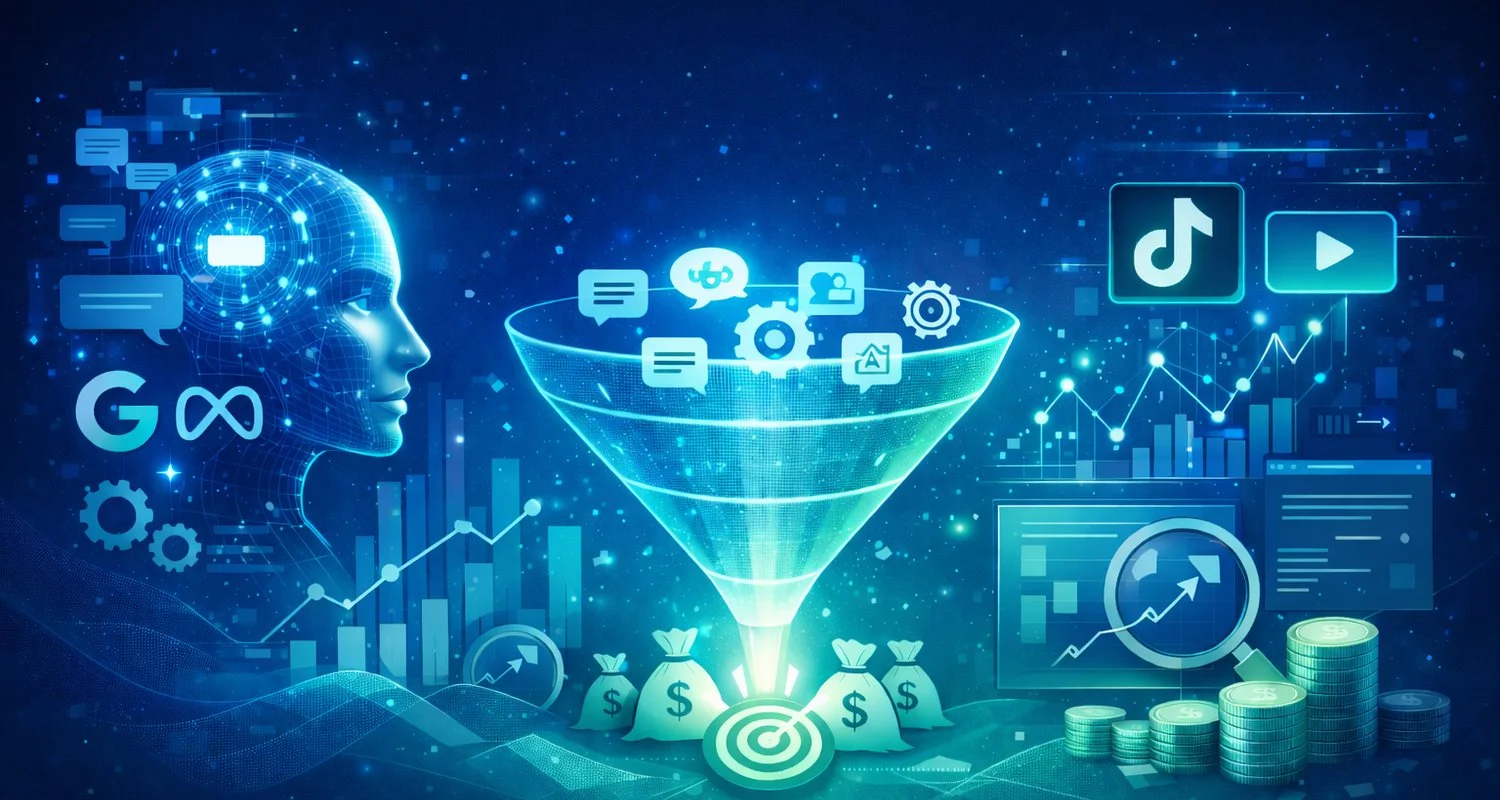
LLMs are quickly becoming the new middle of the funnel.
Historically, the middle funnel lived across:
Search results
Product pages
Reviews
Comparison sites
Content hubs
Users would click through multiple sources to evaluate options. That behavior generated traffic, intent signals, and conversion opportunities.
Now much of that research and validation is happening inside a single interface.
Instead of five searches and ten site visits, a user can ask a few questions and get synthesized answers, recommendations, and comparisons instantly. That compresses the evaluation phase — and when evaluation compresses, the traditional path to conversion changes with it.
Early Signs Are Already Showing Up in Ad Performance
We’re already seeing signs of this shift across the market.
In some categories:
Exploratory search traffic is softening
Research behavior is evolving
Conversion paths are becoming less linear
For advertisers who rely heavily on volume alone, that creates instability.
Less traffic.
Less signal.
More pressure on performance.
But not all programs are affected equally.
Why Some Advertising Programs Are Holding Up Better
The environments built as true growth engines tend to be far more resilient.
A growth engine is not just media spend. It’s a system.
It includes:
Strong conversion tracking that creates clean signal
Deep platform setup so that signal is fully utilized
Disciplined execution across campaigns and channels
Continuous analysis that compounds performance over time
When traffic patterns shift, these systems don’t collapse. They adapt.
Even when raw traffic dips, programs built on strong signal and operational excellence can continue growing revenue and profitability. When platforms receive high-quality conversion data, their optimization models stay effective. When media is run deeply and intentionally, performance remains stable in uncertain environments.
LLM Ads Will Raise the Stakes Even Higher
As LLM platforms introduce advertising, this dynamic will intensify.
If they follow the trajectory of Google and social:
Ad formats will evolve quickly
Measurement will start imperfect and improve over time
Targeting will become more sophisticated
The advertisers best positioned to win won’t just be the first to test.
They’ll be the ones with the strongest underlying systems.
Clean signal will matter more.
Platform depth will matter more.
Execution discipline will matter more.
As attention shifts, the margin for error gets smaller.
Advertising Is Becoming More Structural, Not Just Tactical
For years, many companies treated advertising as a channel decision.
But the landscape is becoming more structural.
The companies best prepared for what’s coming next are the ones that have built real growth engines - systems designed to capture signal wherever it originates, feed it back into platforms effectively, and continuously refine performance as user behavior evolves.
They’re not dependent on one source of traffic.
They’re not dependent on one platform.
And they’re far less exposed when the funnel shifts.
What This Means Going Forward
No one can control how quickly the landscape changes.
But the strength of the system behind your advertising is still within your control.
As LLMs continue absorbing more of the middle funnel and new ad environments emerge, the companies with strong foundations will adapt faster, stabilize performance sooner, and continue compounding results while others struggle to recalibrate.
That’s the real implication of this shift.
