

2026 Best Med Spa Marketing Agencies
A Revenue-Based Evaluation of the Med Spa Marketing Industry
Sep 3 • Written By Jacob Kent and Jason Katz
Executive Summary
Med spa marketing should be measured by patient revenue, not leads. This guide evaluates leading med spa marketing agencies on their ability to acquire qualified patients, expand the value of existing patients, and connect marketing investment to revenue.
Key Findings
Patient acquisition is only the first step. Generating inquiries matters, but the real outcome is getting qualified patients booked, treated, and generating revenue.
Existing patients represent a major growth opportunity. Keeping Botox and filler patients on a maintenance cycle, finishing out laser or body-contouring packages, moving patients into memberships, and cross-selling into adjacent treatments can grow revenue without spending another dollar on new leads.
Analytics should close the loop to patient revenue, not just report on it. The best measurement connects ad spend to actual treatment revenue - and feeds it back into the ad platforms so campaigns optimize toward real patient value, not cheap leads.
The right partner depends on practice size. Independent, single-location spas need a partner who moves fast and works directly with ownership; multi-location groups need centralized strategy and reporting that scales across sites.
The Category Has Broadened
"Med spa" no longer means only injectables and laser. The category now overlaps heavily with medical weight loss and GLP-1 clinics, peptide therapy and longevity practices, hormone optimization, IV/wellness bars, and integrative or functional medicine - and the same framework holds across all of them, just with different mechanics. A GLP-1 patient's "maintenance cycle" is a recurring prescription refill instead of a Botox touch-up. A longevity or hormone practice's expansion leans even harder on membership and subscription revenue than aesthetics does. IV and wellness bars run higher visit frequency at a lower per-visit ticket, which changes the acquisition math but not the underlying question: does the agency's system reach revenue, or stop at the lead? This guide focuses primarily on aesthetics, where the deepest evidence exists, but the acquisition/expansion/analytics framework applies across the broader category.
Full disclosure: This guide is published by Growth Marketing Advisors. GMA Growth Engines is included below and evaluated using the same criteria as the other agencies.
How We Evaluate Agencies
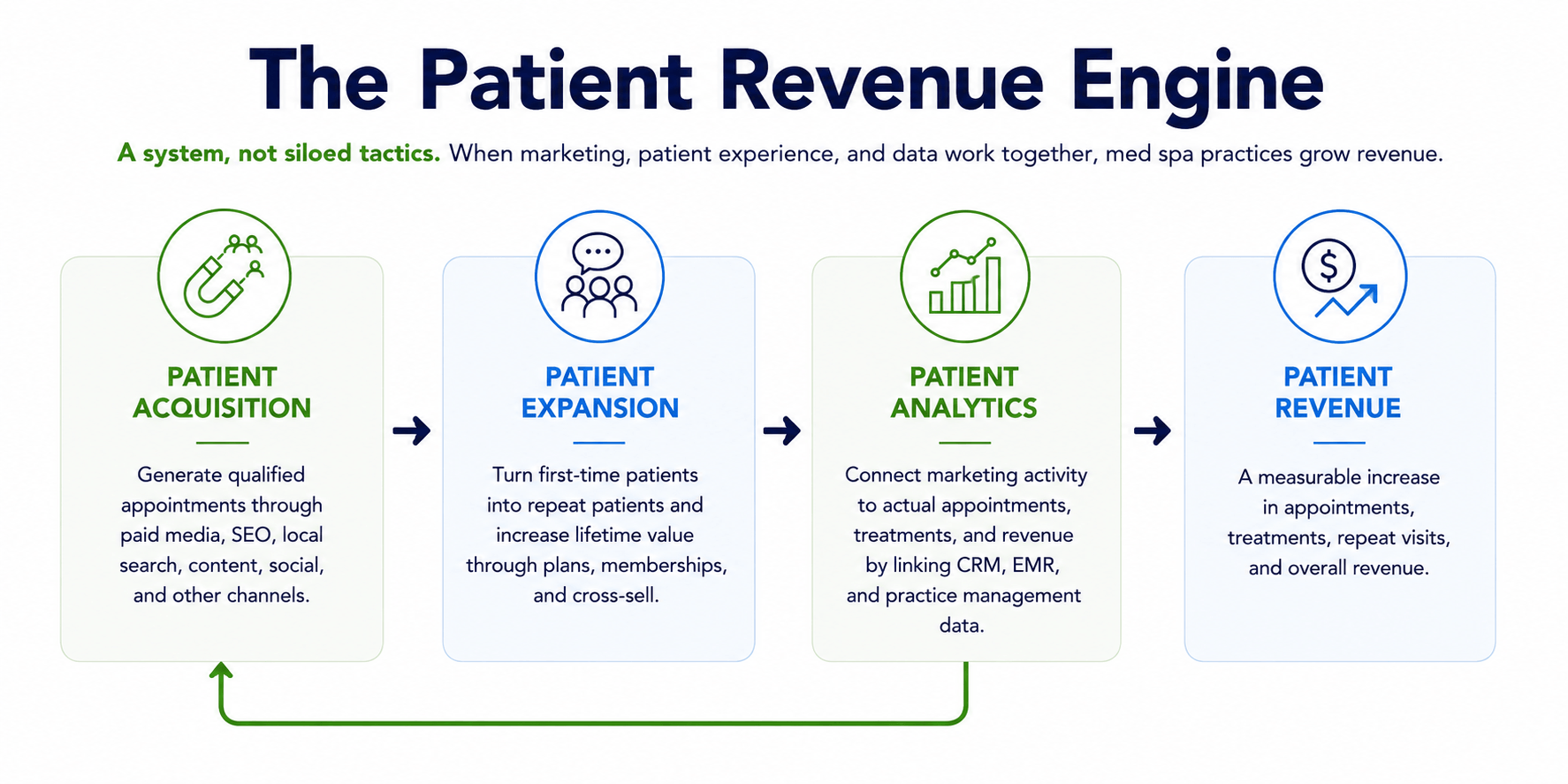
Most agency comparisons score individual services, SEO, paid media, branding, social, as if the best specialist in each category automatically adds up to patient revenue. It doesn't. We evaluate agencies based on how their capabilities contribute directly to the patient revenue.
Patient Acquisition + Patient Expansion + Patient Analytics = Patient Revenue
Branding strengthens each stage of this system, so it’s considered qualitatively within the agency evaluations rather than scored as separate pillars.
Patient Acquisition - How effectively does the agency help practices generate qualified appointments through paid media, SEO, local search, content, social, and other acquisition channels?
Patient Expansion - Does the agency turn one-time patients into repeat ones? A Botox or filler patient staying on a maintenance cycle, a laser or body-contouring patient completing their full package, a patient moving into a membership, a tox patient cross-sold into skincare or injectables - that's expansion. A first appointment alone isn't.
Patient Analytics - Does the agency connect marketing activity to actual appointments, treatments, and revenue - linking CRM, practice management, and EMR data - or does it stop at a dashboard of ad spend and lead counts?
Segmentation: We evaluated agencies across two tiers - Independent & Growth-Stage Med Spas (primarily single-location practices and smaller growing groups, where owners and leadership teams are closely involved in marketing decisions) and Scaled & Multi-Location Med Spas (organizations operating across multiple locations, where centralized strategy, coordinated execution, location-level reporting, and integrated technology become increasingly important).
Featured Agencies at a Glance
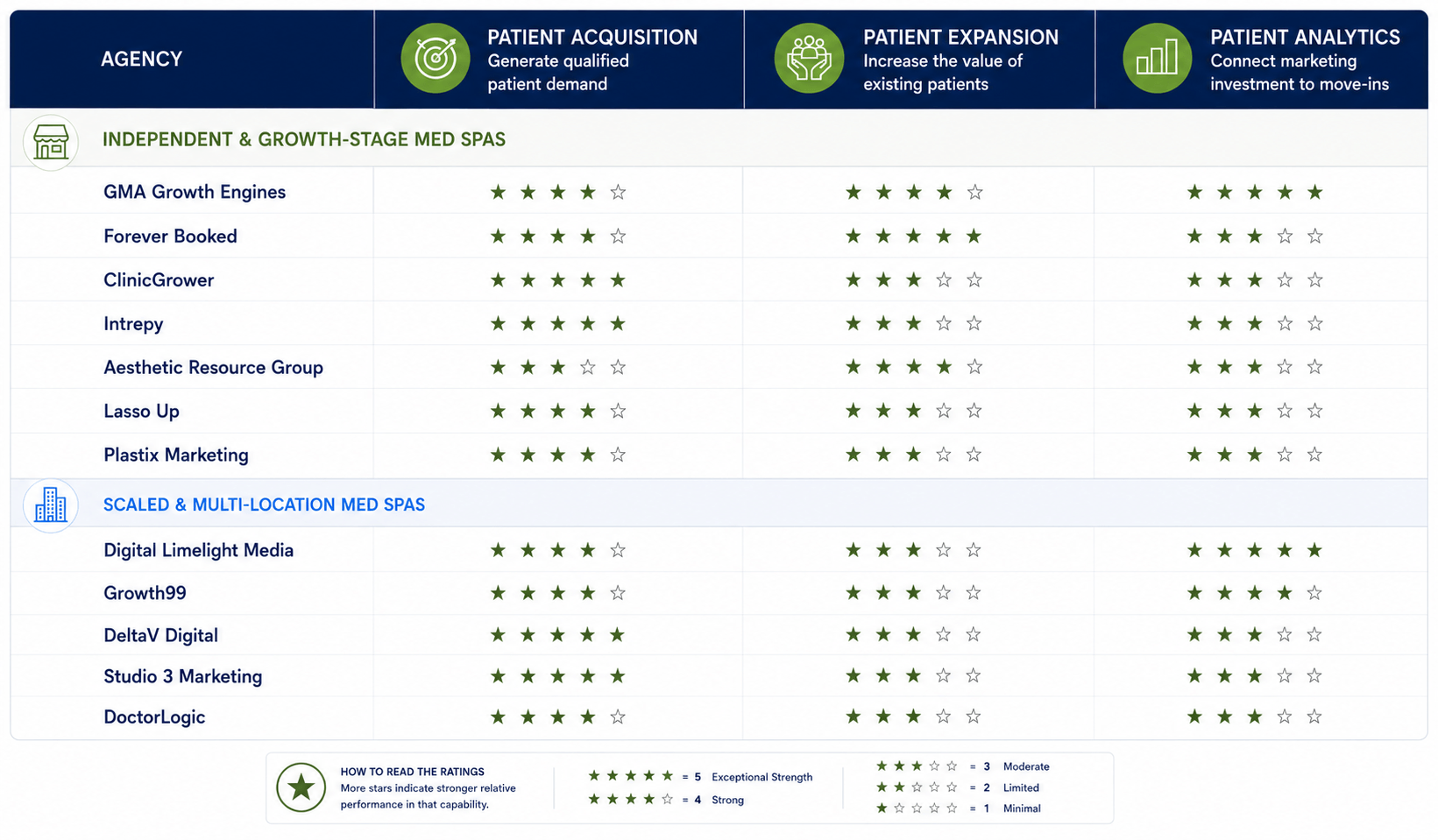
Ratings reflect relative strengths based on publicly available research and are intended for comparison, not absolute performance.
Agency Profiles
The real dividing line in this category isn't creative quality, channel mix, or chatbots - it's how far past the lead an agency's system can actually see, and orchestrate effectively.
Independent & Growth-Stage Med Spas
These agencies are generally best suited to practices where the owner or leadership team wants a specialized growth partner without the infrastructure typically associated with a large enterprise agency.
GMA Growth Engines - Acquisition is built around consult-to-treatment economics, not cheap leads. Expansion continues past the first appointment - maintenance cycles, package completion, cross-sell. Analytics closes the loop: predicted lifetime value and its signals feed back into ad-platform bidding, then automated marketing helps realize it.
Forever Booked - Expansion is the edge here: reactivating dormant patient lists and pushing existing patients into memberships and repeat treatment cycles, proven across multiple years of the same clients' revenue, not just a launch-quarter spike. Acquisition is solid but secondary to the retention-first positioning; the analytics evidence is testimonial-based rather than a documented attribution system.
ClinicGrower - Acquisition is the clear strength with new revenue and ROI cited for aesthetics-specific funnels. Expansion and analytics are less central - strong consult volume, but no published system yet for maintenance-cycle retention or tying revenue back to source past the first booked patient.
Intrepy - The Attract–Convert–Retain framework names all three legs, but the hard evidence sits almost entirely in Attract - lead volume, cost-per-lead, procedure-specific demand. the retention piece doesn't yet have a published maintenance-cycle or membership case behind it, and it's unclear whether the growth dashboards connect to booked revenue.
Aesthetic Resource Group - Operational consulting layered onto marketing: attribution and CRM alongside practice-growth advice across medical aesthetics, plastic surgery, and wellness. Broad by client count, though quantified outcomes across the three pillars haven't been published yet.
Lasso Up - Acquisition efficiency is the strength but it’s lead not revenue focused and the evidence base skews broader healthcare rather than med-spa-specific, with expansion and analytics work specific to the aesthetics patient journey not yet publicly documented.
Plastix Marketing - Real acquisition numbers back this one up: organic revenue, inbound ROI, and a close-rate lift that's a genuine conversion metric, not a vanity one. The chatbot product speeds up that first conversion, but that's still acquisition-adjacent - membership, reactivation, and cross-sell case evidence hasn't been published yet.
Scaled & Multi-Location Med Spas
These agencies have capabilities or demonstrated experience that can be particularly relevant as organizations add locations, centralize marketing, or require more sophisticated digital infrastructure.
Digital Limelight Media - The most credible analytics story outside GMA: EMR integration ties ad spend directly to billed procedures and payments, a shipped, working revenue-attribution product. Acquisition performance across SEO, PPC, and CRO is described but not quantified publicly; expansion - cross-sell, membership, reactivation - exists as a service line without published case evidence yet.
Growth99 - Brings acquisition and patient engagement into one platform, but the most concrete evidence is acquisition-adjacent, not expansion. Gia, its AI front desk, answers every inbound inquiry around the clock to stop leads going cold - a real conversion assist, not a maintenance-cycle or membership program. Analytics runs deep on communication and CRM data, but revenue-attribution hasn't been publicly documented yet.
DeltaV Digital - The strongest multi-location acquisition case in this set: one dermatology client's expansion, with more bookings and lower acquisition cost. Expansion and analytics work specific to med spas - cross-sell, reactivation, revenue attribution - hasn't been published yet.
Studio 3 Marketing - Real scale across aesthetic clients and markets. But that scale is acquisition and visibility, not patient economics - expansion and analytics work tying that scale back to booked revenue hasn't been published yet.
DoctorLogic - Positioned right for multi-location groups on technology and reputation management, but the evidence is thin everywhere except one cited case of a med spa client tripling revenue year-over-year. Expansion and analytics aren't yet backed by public evidence.
Industry Considerations
Cost Per Lead Is a Vanity Metric If It Stops There
CPL tells you how cheaply you filled the top of the funnel - nothing about whether that inquiry became a booked consult, a treated patient, or a returning one. The number that actually matters is cost per acquired patient (CAC) weighed against that patient's lifetime value (CLV). Practices tracking real unit economics generally target a CLV:CAC ratio; if you don't know your ratio, you're optimizing for the wrong number.
For a deeper look at acquisition cost and customer value, read The Economics of Customer Acquisition.
The Money Is in What Happens After the Consult
A booked appointment is the cheapest revenue a med spa will ever generate, because the patient is already acquired. Injectable patients staying on a 3-to-4-month maintenance interval, laser and body-contouring patients completing their full package instead of dropping off after session two, patients converting into memberships, cross-sell into adjacent modalities, and reactivation of a list gone quiet - that's where practices leave the most money on the table, and where most agencies have the least to show for themselves.
Booking Software and EMRs Aren't Attribution Systems
Your EMR knows what procedure was performed. Your booking platform knows who showed up. Neither one, by default, knows which ad, keyword, or campaign produced that specific patient and that specific revenue. Without that link, a practice is stuck optimizing for lead volume because lead volume is the only number anyone can actually see.
Clean Data Should Go Somewhere, Not Just Get Reported On
Knowing which channel produced a patient is only half the job. The real value shows up when that signal - a completed treatment series, a membership conversion, an actual dollar amount, not just an appointment checkbox - flows back into the ad platforms and into marketing automation as a trigger for the next touch. A dashboard that shows what happened last month doesn't change what a campaign does next week. A pipeline that feeds that data into Meta and Google's bidding algorithms, and triggers a recall sequence the moment a patient goes quiet, does.
Discovery Doesn't Start and End on Google Anymore
Patients research on Maps, RealSelf, Instagram, reviews, referrals, and increasingly AI-assisted search - and provider bios and before-and-afters now carry as much weight as paid placement. The goal isn't appearing everywhere; it's knowing which of those sources actually produces patients who book and stay, and building a system that can tell you that.
Selecting the Right Partner
The honest answer to "which pillar matters most" is: all three, because a gap in any one caps what the other two can do. Cheap leads don't matter if no one follows up. Follow-up doesn't matter if the practice can't see which channel actually produced the patient. Ideally a practice doesn't have to trade one pillar for another - but a partner that's genuinely strong across all three, and can document it, is uncommon; most agencies show clear strength in one or two legs, with the third less documented publicly. Use your current constraint to know which questions to press hardest in diligence, not as a reason to lower the bar on the other two.
Ask every agency:
What's our blended cost per booked, treated patient - not just cost per lead - and what CLV:CAC ratio should we expect?
Can you show attribution from ad click through to billed procedure, not just to appointment booked?
What happens to a lead that doesn't book - what's the follow-up sequence, and what's the average lead-to-consult conversion rate?
What does your reactivation and maintenance-cycle program actually look like month to month, not just as a slide?
What results have you produced for a practice with our specific procedure mix?
Red flags: reporting that stops at clicks or leads; an agency that can't state a CLV:CAC ratio or treats the question as beside the point; vague or absent reactivation strategy; no visibility into booked-patient outcomes past the appointment; generic healthcare experience presented as med-spa specialization.
Closing Thoughts
Patient treatment success and revenue is the outcome. Every other number in this guide - leads, CPL, traffic, rankings - is a proxy, useful only to the extent it correlates with booked, treated, paying patients who come back. The strongest systems in this category don't stop measuring at the form fill or the phone call; they follow the patient through the consult, the treatment, the next appointment, and the referral, and they can prove it. That's the bar. Most agencies clear one leg of it. Very few clear all three.
Talk with GMA Growth Engines → To learn how GMA Growth Engines connects Patient Acquisition, Patient Expansion, and Patient Analytics into one measurable system for med spa operators, contact us.
Research Methodology
Agency evaluations are based on publicly available agency websites, case studies, client portfolios, technology information, reviews, industry rankings, and third-party research. Agencies were assessed across Patient Acquisition, Patient Expansion, and Patient Analytics, with published business outcomes weighted more heavily than general service claims. Tier reflects the type of practice each agency appears best suited to serve. Ratings reflect relative strengths based on available evidence, and agencies did not participate in or approve their evaluations.
Frequently Asked Questions
-
A. There's no universal number. A practical budget depends on procedure mix, market density, and growth target. The more useful frame is unit economics: what does a booked patient cost to acquire, and what is that patient worth over the treatment relationship?
-
A. It depends more on what the marketing is running through than on the marketing itself. If tracking, booking flow, and front-desk follow-up are already solid, campaigns can start producing qualified inquiries within weeks - but inquiries aren't results, and treating them as the finish line sets a practice up to be disappointed. It takes longer - usually a few months, not weeks - for enough patients to move through consult, treatment, and a repeat visit to know whether the numbers actually hold up. And if the underlying systems are weak - slow follow-up, high no-show rates, a clunky booking process - faster ad spend just exposes those problems faster; it doesn't fix them. The foundation matters as much as picking a channel.
-
A. CPL measures how cheaply you fill the funnel; cost per patient (and that patient's lifetime value) measures whether the funnel is actually profitable. Track both, but make decisions on the second one.
-
A. Both matter, but expansion - repeat treatments, cross-sell, memberships, reactivation - is usually the cheaper lever, since the patient is already acquired. The right balance depends on which one is currently your growth constraint.
-
A. Lead volume doesn't guarantee bookings. Slow response times, missed calls, inconsistent follow-up, weak lead qualification, limited appointment availability, or friction in the booking process can all create leakage between inquiry and appointment - and it's worth diagnosing which one before spending more on acquisition.