
The Hidden Cost of “Efficient” Marketing

Marketing performance isn’t determined by how much you spend or who you hire - but by what the entire system is optimizing toward.
Most marketing conversations revolve around controllable variables:
Agency fees.
Media budgets.
Cost per lead.
Cost per acquisition.
Those are easy to compare.
They’re measurable. Negotiable. Concrete.
But they’re rarely the largest driver of business performance.
Across industries - real estate, hospitality, healthcare, software, ecommerce, marketplaces - a consistent pattern shows up:
Marketing often becomes very efficient at generating activity.
But the business doesn’t improve proportionally.
Leads increase.
Traffic improves.
Dashboards look better.
Yet occupancy doesn’t meaningfully shift.
Revenue quality stays uneven.
Retention doesn’t improve.
Margin doesn’t expand.
That’s the hidden cost of “efficient” marketing.
It optimizes what’s visible - not necessarily what’s valuable.
The Real Issue Isn’t Price. It’s Optimization.
Companies tend to choose marketing partners based on:
Lower cost
Bigger name
Strong creative
Better reporting
But those criteria don’t determine long-term growth.
What determines growth is whether marketing is aligned with how the business actually creates value.
When decisions - both human and algorithmic - are guided by proxy metrics, marketing scales activity.
When decisions are guided by real business outcomes, marketing begins improving the economics of the business.
That difference compounds over time.
Where Capabilities Usually Live
In most organizations, the necessary capabilities exist - just rarely in the same place.
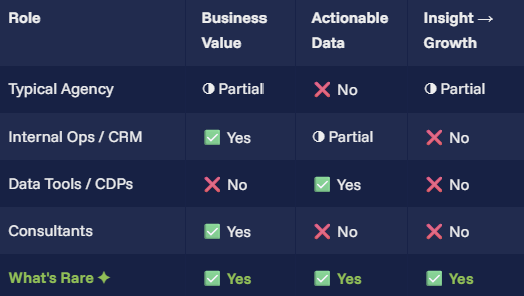
No single group is incompetent.
Agencies execute.
Internal teams understand operations.
Tools move data.
Consultants diagnose.
But growth accelerates when these capabilities operate together.
What Actually Changes When They Do
Every part of marketing adjusts based on the signals it receives about what success looks like for the business.
Campaigns optimize.
Budgets shift.
Creatives evolve.
Audiences refine.
Teams prioritize.
If the feedback reflects surface activity, the system scales surface activity.
If the feedback reflects real business value - revenue realized, profitable occupancy, repeat purchasing behavior, utilization quality - something different happens.
Growth accelerates when the signals that represent real business value guide both the systems running marketing and the people shaping it - allowing marketing to improve the economics of the business, not just campaign metrics.
This isn’t just technical.
It changes creative direction.
It changes targeting logic.
It changes investment decisions.
It changes how teams evaluate success.
Marketing stops behaving like a collection of campaigns.
It starts behaving like a growth engine.
The Market Gap
Marketing platforms optimize whatever data reaches them.
In many organizations, the most important business data never does.
Revenue lives in one system.
Operational data lives in another.
Campaign performance lives somewhere else.
When those signals remain fragmented, marketing optimizes proxies.
When real business outcomes begin informing tools, teams, and campaigns together, decisions align.
Technology reveals value.
Experience determines how to pursue it.
That combination is what creates durable growth.
The Buying Mistake
When marketing is evaluated primarily on cost or activity, organizations tend to hire accordingly.
When it’s evaluated on business outcomes, a different kind of partnership becomes necessary.
Both low-cost and high-cost agencies can produce strong campaigns.
DIY efforts can work in certain stages.
Large firms can deliver impressive brand presence.
But none of those variables alone determine whether marketing improves the P&L.
Choosing based on cost alone misunderstands how growth actually happens.
Because the real question isn’t:
“How efficient is this marketing?”
It’s:
“What definition of value is shaping marketing decisions?”
That answer determines whether marketing generates activity -
or contributes meaningfully to the business itself.
